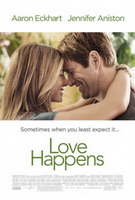
Warning, do not be fooled by the title; it does hold true, but love maybe taking a backseat in this one.
Love Happens is a romantic drama, which centers on the famous author Dr. Burke Ryan (Aaron Eckhart). After the passing of his wife, he has since written a book, A-Okay, which helps readers move on after losing loved ones. Returning to his hometown Seattle, Ryan is on the verge of a mega-money marketing deal while he is teaching a weeklong, sold-out seminar based on his book at a hotel.
Despite the fame, Ryan lives a miserable life since the death of his wife three years prior. Hypocritically, he refuses to practice what he preaches and move on with his life. While at the hotel, Ryan unexpectedly bumps into a beautiful florist, Eloise Chandler (Jen Anniston), who has her own love problems. With the help of one another, the duo makes sense of their pasts and the direction of their futures.
The romance gets off to an odd start. Something about the beginning of the relationship did not quite click with me; maybe it was the nasty confrontation or awkward first date. Once settled, Aniston and Eckhart were a nice match; for the most part, the chemistry was solid. Aniston’s role was fairly simple, and very much like most of her previous movie characters. Eckhart’s performance in Love Happens is very impressive; he accurately plays the tall order of inspiration, sorrow, plus romance.
Perhaps the most powerful portion of the film is offered in a subplot. A troubled man named Walter (John Carroll Lynch) attends Ryan's seminar after losing his son in a construction accident a few years ago. Failing to get his life together since, Walter is frustrated with the seminar and nearly leaves. Convincing him to stay, Ryan helps Walter ‘take a step’ in the right direction in a moving series of events.
The supporting cast offers some brief, but essential light humor in the film. Dan Fogler plays Lane, who is Burke Ryan’s manager and publicist. Judy Greer plays the character Marty, an employee at Eloise’s flower shop.
Debuting director Brandon Camp structures the film to flow beautifully and even illuminates the beauty and gloom of Seattle. The rainy backdrop is very fitting, considering the theme of mourning in the story. The editing remains simple and appropriate through the story. The camera never seems to be out of place and moves smoothly throughout. I appreciated the unique camera angles he threw in from time to time. Camp does incorporate some noticeable product placement in the movie (Home Depot, Century Tel). The light narratives of Ryan in the beginning and end were suitable; they expose some of the detail in his book. Providing some Pacific Northwest local flavor, the master shots are beautiful throughout the film. The film even has a deadline, Walter Benjamin would be proud.
As a meticulous music critic, I admit the sounds in Love Happens compliment the scenes remarkably well. The soundtrack is mostly composed of contemporary hit artists: Rogue Wave, The Eels, Postal Service and more. The part that sticks out in my mind most is a powerful scene focused on Walter that is backed by the stunning instrumental services of Explosions in the Sky (heard in Friday Night Lights).
Love Happens does not quite reach the level of an instant classic; it had some minor faults. Certain dialogue could have been improved. It may have just been me, but something about the kickoff to their romance still bothers me. Lastly, a minor plot involving a parrot emerges in the end, which I felt was over hyped.
If you are looking for film solely based on uplifting romance, like the title suggests, this one may not be your style. Love Happens strays from its title by diving into the emotional topic of mourning, where uncomfortable subplots are unveiled. The movie gets intense during seminar scenes. I found drastically different feelings emerge while watching this movie, I was anywhere from rooting for a relationship to on the brink of tears. Camp provides a multifaceted feature by touching on fear, friendship, mourning, and love. The contrasts and shifts in focus may not be for everyone, but it did have my attention the whole time.
The film has some minor downfalls, but more positives. Gorgeously shot, Love Happens was an odd, but unique trio of sad, cute, and entertaining all at the same time. With a more intense approach, Love Happens offers a taste of originality to romance. Camp may have been a first time director, but the quality does not reflect that of a rookie. Bottom line: Love Happens is A-Okay.

